
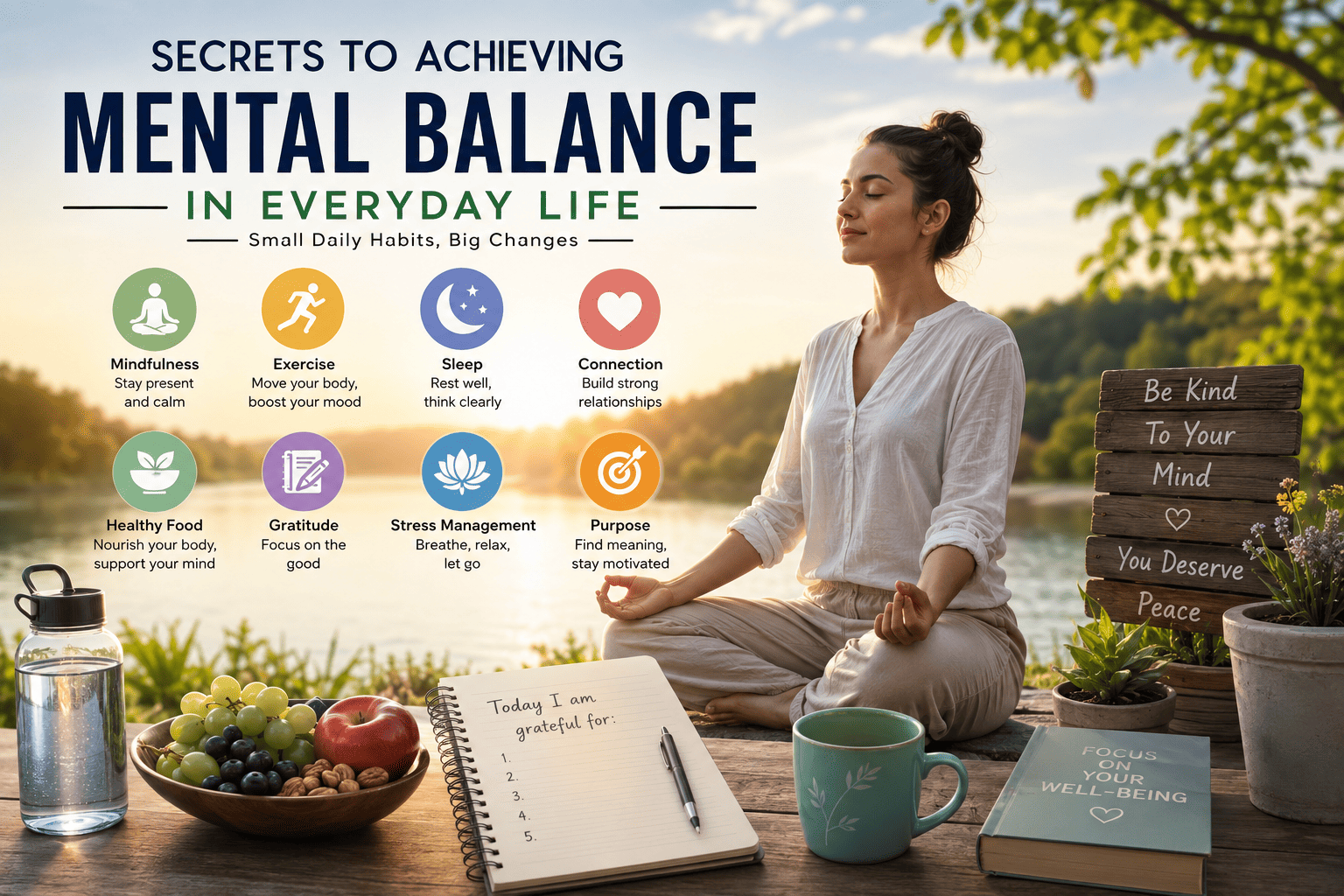
Introduction
In today’s fast-paced world, maintaining mental balance has become one of the greatest challenges people face. Daily responsibilities, work pressure, financial concerns, family obligations, and constant exposure to digital media can gradually affect emotional stability. As a result, increasing numbers of individuals experience stress, anxiety, emotional exhaustion, and burnout.
Fortunately, modern psychology and neuroscience have shown that mental wellness is not merely the absence of mental illness but a dynamic state that can be strengthened through healthy habits, emotional awareness, and evidence-based strategies. Scientific research conducted by leading experts in Asia, Europe, and North America demonstrates that emotional resilience, mindfulness, physical activity, quality sleep, healthy nutrition, and supportive social relationships play fundamental roles in maintaining psychological health.
This comprehensive guide explores the secrets of achieving mental balance in daily life, supported by recent medical studies, expert recommendations, and practical strategies that anyone can apply. Whether you seek to reduce stress, improve emotional resilience, or simply enjoy a healthier and happier life, the following evidence-based insights provide a roadmap toward lasting psychological well-being.
What Is Mental Balance?
Mental balance refers to the ability to maintain emotional stability while effectively coping with life’s challenges. It does not imply constant happiness but rather the capacity to adapt to changing circumstances without becoming overwhelmed.
According to the World Health Organization (WHO), mental health enables individuals to realize their abilities, manage normal life stresses, work productively, and contribute positively to society.
Key Characteristics of Mental Balance
| Characteristic | Description |
|---|---|
| Emotional regulation | Managing emotions without suppressing them |
| Psychological resilience | Recovering from setbacks effectively |
| Positive thinking | Maintaining realistic optimism |
| Healthy relationships | Building supportive social connections |
| Self-awareness | Understanding personal emotions and behaviors |
| Purpose in life | Having meaningful goals and values |
Why Mental Balance Matters
Scientific evidence consistently shows that maintaining psychological well-being improves nearly every aspect of health.
Benefits include:
- Lower stress hormone (cortisol) levels
- Improved immune function
- Better cardiovascular health
- Enhanced memory and concentration
- Stronger interpersonal relationships
- Better work productivity
- Reduced risk of anxiety disorders
- Reduced risk of depression
- Increased longevity
- Higher overall life satisfaction
The Science Behind Mental Well-Being
Modern neuroscience has transformed our understanding of emotional health.
Researchers from Harvard Medical School, Stanford University, University College London, and Kyoto University have demonstrated that the human brain remains adaptable throughout life through a process called neuroplasticity.
This means healthy daily habits can physically strengthen brain regions involved in:
- Emotional regulation
- Decision-making
- Stress management
- Memory
- Attention
- Self-control
Secret 1 : Practice Mindfulness Every Day
One of the most effective methods for achieving mental wellness is mindfulness meditation.
Mindfulness involves paying attention to the present moment without judgment.
Medical imaging studies show that regular mindfulness practice increases activity in the prefrontal cortex while reducing overactivity in the amygdala—the brain’s fear center.
Scientific Evidence
Researchers led by Dr. Sara Lazar at Harvard Medical School found measurable structural brain changes after only eight weeks of mindfulness training, including increased gray matter density in regions associated with emotional regulation and learning.
Daily Mindfulness Routine
| Time | Activity |
|---|---|
| Morning | Five minutes of deep breathing |
| Afternoon | Mindful walking |
| Evening | Gratitude reflection |
| Before sleep | Guided meditation |
Secret 2 : Exercise for Both Mind and Body
Physical activity is one of the most powerful natural antidepressants.
Exercise stimulates the release of:
- Endorphins
- Serotonin
- Dopamine
- Brain-Derived Neurotrophic Factor (BDNF)
These chemicals improve mood while supporting brain function.
Recommendations
The American College of Sports Medicine recommends:
- 150 minutes of moderate exercise weekly
- Muscle-strengthening exercises twice weekly
- Daily walking whenever possible
Secret 3 : Prioritize High-Quality Sleep
Sleep deprivation negatively affects nearly every psychological process.
Research from the University of California demonstrates that poor sleep amplifies emotional reactions while impairing rational thinking.
Healthy Sleep Habits
- Maintain a consistent bedtime.
- Limit screen exposure before sleep.
- Keep the bedroom cool and quiet.
- Avoid caffeine late in the day.
- Develop a relaxing bedtime routine.
Secret 4 : Build Strong Social Connections
Humans are naturally social beings.
A decades-long study from Harvard University concluded that the strongest predictor of long-term happiness is not wealth or fame but the quality of close relationships.
Supportive friendships help reduce:
- Anxiety
- Depression
- Loneliness
- Emotional distress
Secret 5 : Eat for Brain Health
Nutrition significantly influences emotional well-being.
Recent studies highlight the importance of the gut-brain axis, showing that intestinal bacteria communicate with the brain through neural, immune, and hormonal pathways.
Brain-Friendly Foods
| Food | Mental Health Benefit |
|---|---|
| Salmon | Omega-3 fatty acids support brain function |
| Blueberries | Rich in antioxidants |
| Nuts | Improve cognitive performance |
| Yogurt | Supports gut microbiome |
| Leafy greens | Reduce inflammation |
| Dark chocolate | May improve mood in moderation |
Secret 6 : Learn Emotional Resilience
Resilience is the ability to recover after adversity.
Psychologists emphasize that resilient individuals:
- Accept setbacks
- Learn from mistakes
- Adapt quickly
- Maintain hope
- Focus on solutions
Resilience can be strengthened through daily practice.
Secret 7 : Limit Digital Overload
Excessive social media use has been linked to increased anxiety, sleep disruption, and reduced life satisfaction.
Experts recommend:
- Scheduled screen-free periods
- Turning off unnecessary notifications
- Avoiding social media before bedtime
- Spending more time outdoors
Secret 8 : Practice Gratitude
Positive psychology research demonstrates that gratitude significantly improves emotional health.
Keeping a gratitude journal can:
- Increase optimism
- Improve sleep
- Strengthen relationships
- Reduce symptoms of depression
Simply writing three positive experiences each day can gradually reshape thought patterns.
Secret 9 : Develop Healthy Stress Management Techniques
Stress cannot always be avoided, but it can be managed effectively.
Healthy coping strategies include:
- Deep breathing
- Yoga
- Nature walks
- Journaling
- Creative hobbies
- Listening to music
Secret 10 : Find Meaning and Purpose
People who identify meaningful life goals often demonstrate greater emotional resilience and psychological well-being.
Purpose provides motivation during difficult times and encourages healthier lifestyle choices.
Medical Research from Asia, Europe, and America
The following table summarizes notable scientific contributions from different regions.
| Region | Researchers | Major Findings |
|---|---|---|
| Asia | Researchers at Kyoto University (Japan) | Mindfulness practices improve emotional regulation and reduce stress markers. |
| Asia | Peking University (China) | Regular physical activity is associated with lower rates of anxiety and depression among adults. |
| Europe | University College London (UK) | Social support and healthy lifestyle habits significantly improve long-term mental well-being. |
| Europe | Karolinska Institute (Sweden) | Sleep quality is strongly associated with emotional stability and cognitive performance. |
| North America | Harvard Medical School (USA) | Mindfulness meditation produces measurable structural changes in the brain related to emotional regulation. |
| North America | Stanford University (USA) | Self-compassion and emotional awareness reduce chronic stress and improve resilience. |
Daily Mental Balance Checklist
Morning
✓ Deep breathing
✓ Healthy breakfast
✓ Positive intention

Afternoon
✓ Physical activity
✓ Hydration
✓ Short mindfulness break

Evening
✓ Family conversation
✓ Gratitude journal
✓ Reading
✓ Quality sleep
Essential Tips for Long-Term Mental Wellness
- Practice mindfulness daily.
- Stay physically active.
- Eat a balanced diet rich in whole foods.
- Prioritize consistent, restorative sleep.
- Build supportive relationships.
- Spend time in nature regularly.
- Reduce excessive digital consumption.
- Develop emotional resilience through self-reflection.
- Seek professional help when emotional difficulties persist.
- Continue learning and engaging in meaningful activities.
Conclusion
Achieving mental balance in everyday life is not the result of a single habit but the outcome of many small, consistent actions practiced over time. Scientific evidence from leading researchers across Asia, Europe, and North America confirms that psychological well-being is deeply connected to physical health, nutrition, sleep, social relationships, mindfulness, and purposeful living.
Rather than striving for perfection, individuals should focus on building sustainable routines that support emotional resilience and personal growth. Even modest daily improvements—such as practicing gratitude, exercising regularly, improving sleep quality, or spending meaningful time with loved ones—can have profound long-term effects on mental health.
As neuroscience continues to reveal the remarkable adaptability of the human brain, it becomes increasingly clear that everyone has the capacity to strengthen emotional well-being through informed choices and healthy habits. By embracing evidence-based practices and maintaining a balanced lifestyle, we can cultivate lasting inner peace, greater happiness, and a healthier future.
References
- World Health Organization (WHO). Mental Health. https://www.who.int/health-topics/mental-health
- American Psychological Association (APA). Stress and Mental Health. https://www.apa.org
- Harvard Medical School. Lazar, S. et al. Research on mindfulness and brain structure.
- Stanford University School of Medicine. Research on emotional resilience and self-compassion.
- University College London (UCL). Studies on mental well-being and public health.
- Karolinska Institutet (Sweden). Research on sleep and psychological health.
- Kyoto University (Japan). Mindfulness and neuroscience research.
- Peking University Health Science Center (China). Physical activity and mental health studies.
- National Institutes of Health (NIH). https://www.nih.gov
- National Library of Medicine (PubMed). https://pubmed.ncbi.nlm.nih.gov
- Nature Reviews Neuroscience. https://www.nature.com/nrn
- The Lancet Psychiatry. https://www.thelancet.com
- JAMA Psychiatry. https://jamanetwork.com/journals/jamapsychiatry
- BMJ Mental Health. https://mentalhealth.bmj.com
- Wikipedia. Mental Health, Mindfulness, Positive Psychology, and related entries for general background information.
Leave a Reply